





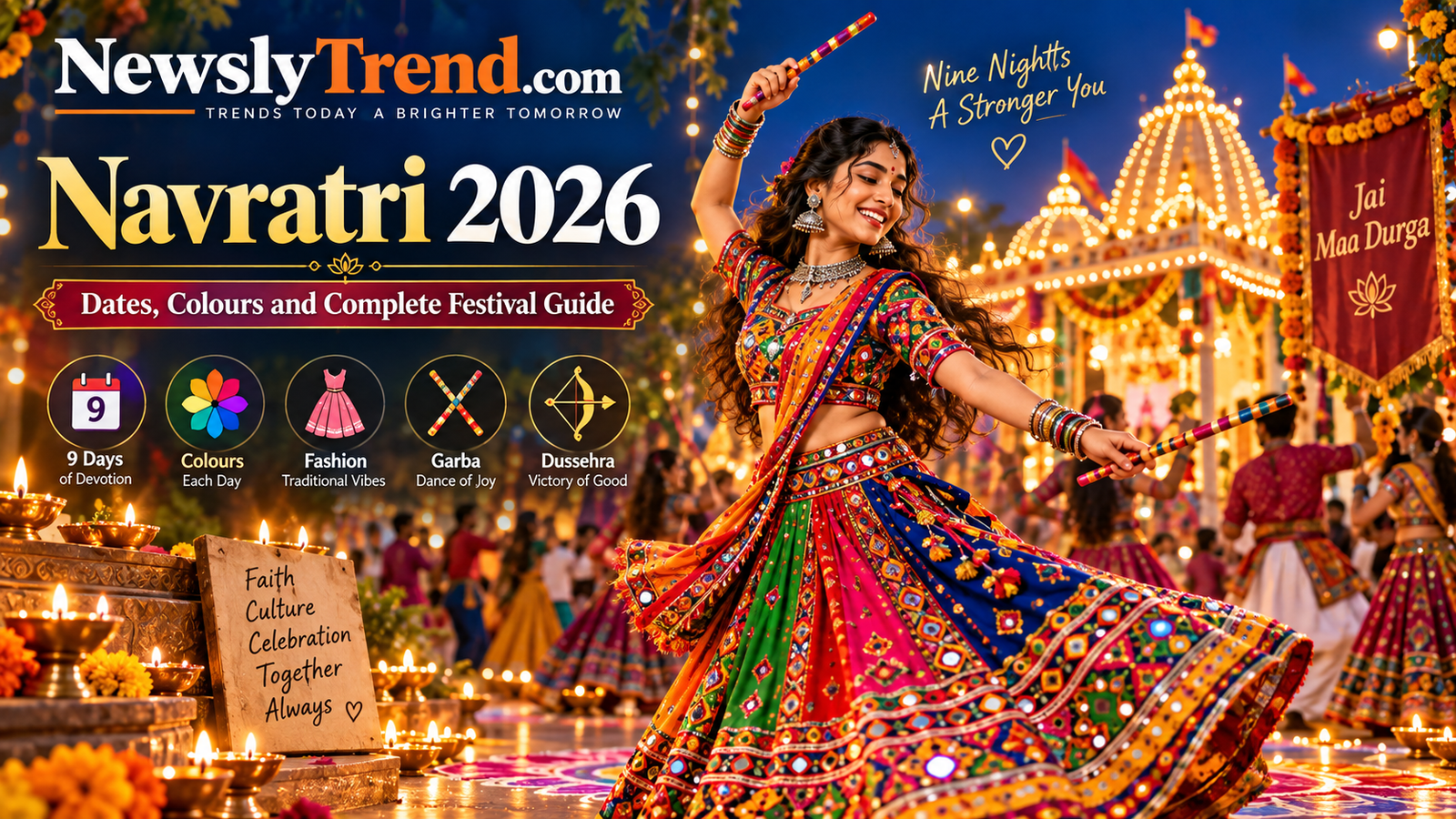



Navratri 2026 Dates and Colours: Complete 9-Day Calendar, Dussehra Date and Festive Trends
The countdown to one of India’s most colourful festive periods has begun.
Shardiya Navratri 2026 will begin on Sunday, October 11 and continue through Monday, October 19, followed by Vijayadashami or Dussehra on Tuesday, October 20, according to widely followed Hindu calendars.
For millions of families, Navratri represents nine days of devotion, fasting, worship and celebration. But over the years, the festival has also evolved into a major cultural season incorporating Garba nights, Dandiya celebrations, fashion, travel, food, social gatherings and festive shopping.
And because Navratri begins on a Sunday in 2026, the year’s popular nine-colour sequence begins with orange.
Navratri 2026: Complete Dates and Colours
| Day | Date | Goddess Traditionally Worshipped | Colour |
|---|---|---|---|
| Day 1 | Sunday, October 11 | Maa Shailputri | Orange |
| Day 2 | Monday, October 12 | Maa Brahmacharini | White |
| Day 3 | Tuesday, October 13 | Maa Chandraghanta | Red |
| Day 4 | Wednesday, October 14 | Maa Kushmanda | Royal Blue |
| Day 5 | Thursday, October 15 | Maa Skandamata | Yellow |
| Day 6 | Friday, October 16 | Maa Katyayani | Green |
| Day 7 | Saturday, October 17 | Maa Kalaratri | Grey |
| Day 8 | Sunday, October 18 | Maa Mahagauri | Purple |
| Day 9 | Monday, October 19 | Maa Siddhidatri | Peacock Green |
| Vijayadashami | Tuesday, October 20 | Dussehra | — |
The widely followed 2026 colour sequence is orange, white, red, royal blue, yellow, green, grey, purple and peacock green.
Local tithis and specific puja timings can vary by location, so families following particular regional traditions should consult their local panchang or priest for city-specific timings.
Why Do Navratri Colours Change Every Year?
One of the most searched questions around Navratri is why the sequence of colours changes.
The popular Navratri colour tradition followed particularly strongly in parts of western India associates colours with the weekday on which Navratri begins.
Since Shardiya Navratri begins on a Sunday in 2026, orange becomes the first colour, followed by the sequence associated with subsequent weekdays.
For many devotees today, wearing the day’s colour has become both a cultural expression and a way of participating collectively in the festival.
Schools, offices, residential societies and Garba events frequently incorporate the daily colours into their celebrations.
October 11: Navratri Day 1 — Orange
Navratri begins with Ghatasthapana and worship of Maa Shailputri.
Orange is associated popularly with energy, warmth and enthusiasm.
Fashion-wise, orange works particularly well with traditional mirror work, oxidised jewellery and contrasting blue or green accessories.
Instead of purchasing a completely new outfit, 2026’s growing sustainable-fashion trend also makes it easy to use orange dupattas, scarves, jewellery or jackets with existing clothes.
October 12: Day 2 — White
The second day is dedicated to Maa Brahmacharini.
White represents simplicity and serenity and remains one of the easiest Navratri colours to style.
White chikankari, cotton, linen and embroidered kurtas can work for daytime puja as well as evening celebrations when paired with colourful jewellery or dupattas.
October 13: Day 3 — Red
Red enters the Navratri palette on the third day.
For Indian festive fashion, few colours carry the visual impact of red.
Traditional lehengas, sarees and anarkalis naturally work well, but younger consumers increasingly combine ethnic elements with crop jackets, contemporary silhouettes and Indo-western accessories.
October 14: Day 4 — Royal Blue
Royal blue gives Navratri styling a dramatic change.
It works particularly well for evening Garba celebrations because metallic, silver and mirror-work detailing tends to stand out against deeper blue shades.
For men, royal-blue kurtas paired with neutral trousers or traditional jackets can provide an easy festive look without becoming excessively formal.
October 15: Day 5 — Yellow
Yellow brings one of the brightest looks of the nine-day festival.
It remains particularly popular for daytime gatherings and photographs because of its naturally vibrant appearance.
Mustard, lemon, sunflower and golden-yellow shades allow plenty of variation without departing from the day’s colour.
October 16: Day 6 — Green
Green dominates the sixth day.
Emerald, bottle green, parrot green and pastel shades can all be interpreted within the theme.
Green also provides an opportunity for nature-inspired decoration, floral styling and environmentally conscious festival themes.
October 17: Day 7 — Grey
Grey might initially sound like an unusual festive colour, but that is precisely what makes the seventh day’s styling interesting.
Silver embroidery, metallic jewellery, sequins and colourful dupattas can transform a simple grey base into a striking evening outfit.
For people who prefer understated fashion, this may be one of the easiest days of Navratri.
October 18: Day 8 — Purple
Purple is associated with Day 8 in the popular 2026 sequence.
From deep plum to lavender and violet, the colour offers considerable flexibility.
Durga Ashtami celebrations around this stage of Navratri are particularly important for many families, although observances and exact tithis can vary regionally.
October 19: Day 9 — Peacock Green
The final colour of the popular nine-day sequence is peacock green.
The shade works naturally with blue, gold and traditional embroidered accessories, making it particularly suitable for elaborate Navratri and Garba outfits.
October 19 is also associated with important concluding Navratri observances before Vijayadashami.
When is Dussehra in 2026?
For the widely followed Shardiya Navratri calendar, Vijayadashami or Dussehra falls on Tuesday, October 20, 2026.
Dussehra commemorations differ significantly across India.
In northern India, large-scale Ramlila performances and Ravana effigy burning remain prominent traditions.
In other regions, Vijayadashami has different religious and cultural forms, while Bengal’s Durga Puja follows its own detailed tithi-based schedule and customs.
That diversity is one of the defining characteristics of India’s festival calendar.
Navratri 2026 Will Also Be a Major Shopping Season
Navratri is no longer isolated from India’s broader retail calendar.
It effectively marks the beginning of one of the strongest consumption periods of the year, extending toward Dussehra and Diwali.
This year’s two largest e-commerce events begin immediately before Navratri.
Amazon’s Great Indian Festival starts on October 8, while Flipkart’s Big Billion Days begins generally on October 9, with eligible customers receiving early access from October 8.
Fashion, smartphones, electronics, beauty, jewellery, home decoration and kitchen appliances are therefore likely to dominate online searches going into Navratri.
The Rise of AI-Assisted Festive Shopping
There is another interesting trend shaping the 2026 festive season.
Consumers are beginning to use artificial-intelligence tools as shopping assistants.
Amazon has already been highlighting AI-powered capabilities such as Rufus, visual search, review highlights and price-history tools for festive shopping.
Independent consumer research also suggests AI chatbots are increasingly being used to research purchases online.
That means someone planning a Navratri outfit may increasingly ask an AI assistant to suggest combinations rather than manually opening dozens of shopping pages.
It represents a quiet but significant change in how festive trends spread.
Garba Fashion in 2026: Reuse Could Become the New Trend
Navratri traditionally creates demand for multiple outfits because of the nine-colour calendar.
But buying nine completely separate outfits is neither economical nor necessary.
A smarter 2026 wardrobe could revolve around a smaller number of base garments combined with different dupattas, jackets, jewellery, waistcoats and accessories.
This creates nine distinct looks without buying nine full ensembles.
The same principle works particularly well for men’s kurtas.
A neutral kurta can be restyled repeatedly through colourful Nehru jackets, stoles and footwear.
Navratri Goes Digital Without Losing Its Roots
What makes Navratri particularly fascinating in 2026 is the way ancient tradition and modern digital culture continue to coexist.
A devotee may begin the morning with puja, coordinate the day’s traditional colour through WhatsApp groups, purchase Garba tickets digitally, discover an outfit through Instagram, compare products through AI and make the final payment through UPI.
None of those technologies necessarily replace tradition.
Instead, they are becoming new channels through which traditions are organised, discovered and shared.
Final Word
Navratri 2026 begins on October 11, bringing nine days of devotion, colour and celebration before Dussehra on October 20.
The year’s popular colour sequence begins with orange and moves through white, red, royal blue, yellow, green, grey, purple and peacock green.
Whether you observe Navratri primarily as a period of worship, participate in Garba and Dandiya, follow the nine-colour tradition or simply enjoy India’s festive atmosphere, October 2026 is set to become one of the most vibrant periods of the year.
And with major online sales beginning just days before Navratri, India’s cultural and consumer calendars will once again come together in a uniquely Indian celebration of tradition, technology and colour.