









This article is based on and extracted from the keynote address delivered by Mukesh D. Ambani, Chairman and Managing Director, Reliance Industries Limited, at the India AI Impact Summit 2026 held in New Delhi on 19 February 2026.
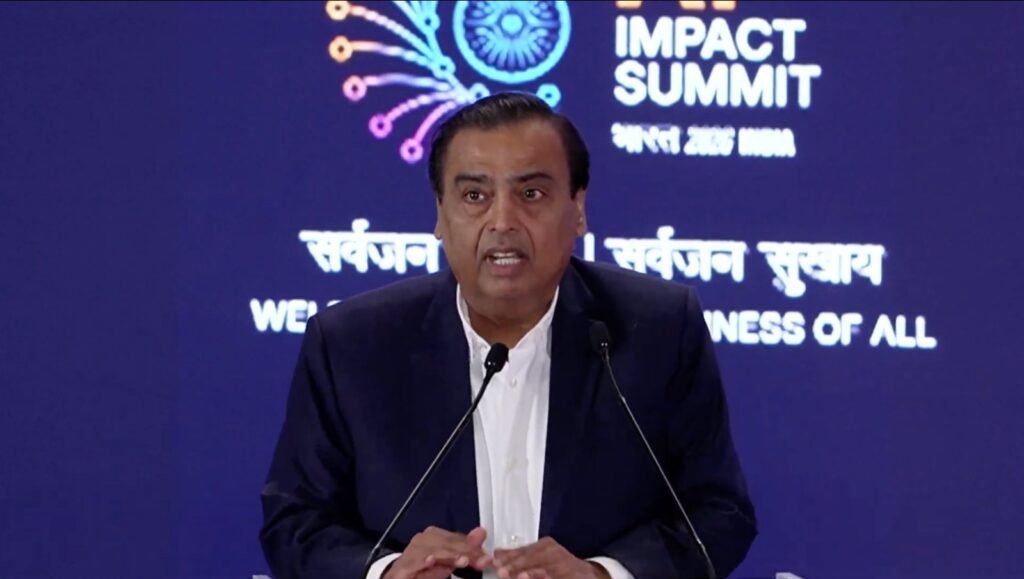
India’s technological journey has moved through several defining phases—from the IT services boom of the 1990s to the mobile data revolution of the 2010s. Now, according to Reliance Industries Chairman Mukesh D. Ambani, the country stands at the threshold of its most transformative era yet: the age of Artificial Intelligence as national infrastructure. Speaking at the India AI Impact Summit 2026 in New Delhi, Ambani delivered a keynote that was less a corporate announcement and more a blueprint for India’s economic and technological future.
Framing AI as a “modern-day Akshaya Patra,” Ambani described it as a limitless source of knowledge, productivity, and prosperity—capable of transforming every sector, from agriculture and education to healthcare and manufacturing. But his message went far beyond metaphor. With the announcement of a ₹10 lakh crore investment over seven years and the creation of sovereign compute infrastructure, he positioned India not just as an adopter of AI, but as a global architect of the intelligence economy.
At the heart of his address was a powerful idea: India cannot afford to rent intelligence. In a world where compute power, data, and AI models are increasingly concentrated in a few nations and corporations, Ambani argued that digital sovereignty will define the next phase of economic independence. By building gigawatt-scale data centres, integrating green energy, and deploying nationwide edge compute networks, Jio aims to make AI as ubiquitous and affordable as mobile data.
What made the speech particularly significant was its emphasis on inclusion. Unlike many global AI narratives focused on large enterprises or advanced research labs, Ambani repeatedly highlighted farmers, students, small businesses, and the informal sector. His vision is of an India where a kirana store owner, a rural teacher, or a small manufacturer can access AI tools in their own language—instantly, affordably, and at scale.
He also placed India’s AI ambitions within a broader geopolitical and economic context. As the world debates whether AI will concentrate power or democratize opportunity, Ambani positioned India as the champion of the latter path—one where intelligence is affordable, accessible, and globally collaborative. Backed by a billion internet users, the world’s largest digital identity system, and a thriving startup ecosystem, he argued that India possesses a unique combination of demographic strength, digital infrastructure, and data generation that no other nation can replicate.
More importantly, the speech reframed AI from being just another technological wave to being core national infrastructure, akin to electricity, roads, or telecommunications. If connectivity defined the last decade, intelligence will define the next. And with massive investments, sovereign compute, multilingual AI, and sector-specific applications already underway, the foundations of this intelligence economy are being laid at unprecedented speed.
For India’s businesses, especially MSMEs, the implications are profound. The coming decade may not simply be about adopting AI tools, but about operating within an AI-first economic ecosystem—one where productivity, decision-making, customer engagement, and even product development are driven by intelligent systems.
Mukesh Ambani’s keynote was therefore more than a speech. It was a declaration that India’s next growth engine will not just be digital—it will be intelligent, inclusive, and globally influential.A Defining Moment in India’s Tech History.
Speaking at the India AI Impact Summit 2026, Mukesh Ambani declared that India stands at the beginning of a historic transformation.
He predicted:
“India will emerge as one of the greatest AI powers in the world in the 21st century.”
AI as the Engine of Viksit Bharat
Ambani aligned his vision with Prime Minister Narendra Modi’s goal of:
A developed India by 2047.
He described AI as the technology that could:
- Eliminate poverty
- Boost productivity
- Drive global prosperity
The Global AI Divide
Ambani warned of two possible futures:
Scenario 1: Concentrated AI Power
- Compute controlled by a few nations
- High costs of AI access
- Widening global inequality
Scenario 2: Democratized AI
- Affordable intelligence
- Global collaboration
- Inclusive growth
He positioned India as the leader of the second, inclusive AI future.
India’s Digital Strengths: The Foundation of AI Leadership
Ambani highlighted India’s achievements:
- Nearly 1 billion internet users
- Among the world’s lowest data costs
- Aadhaar covering 1.4 billion citizens
- 12 billion UPI transactions monthly
- 100,000 startups and 100+ unicorns
He called these achievements the foundation of India’s AI dominance.
The ₹10 Lakh Crore AI Investment
Reliance will invest:
₹10 lakh crore over seven years
Key areas:
- AI infrastructure
- Data centres
- Edge computing
- AI platforms
This is one of the largest private AI investments globally.
Sovereign AI Infrastructure
Ambani stressed the importance of:
- Domestic compute capacity
- Local data processing
- Strategic digital independence
He said:
“India cannot afford to rent intelligence.”
AI Across Key Sectors
Ambani identified several sectors where AI will drive transformation:
Education
AI teachers for millions of students.
Healthcare
Instant medical guidance through AI assistants.
Agriculture
Satellite-based advisory for farmers.
Retail and Services
Voice-first AI tools for small businesses.
The Five Principles of Jio Intelligence
Ambani outlined five core principles:
- AI for deep-tech and manufacturing leadership
- Multilingual AI across Indian languages
- Security, data residency, and trust
- Job creation through AI adoption
- Strong ecosystem partnerships
India’s Six Strategic Advantages
Ambani described India’s unique AI strengths:
- Demography
- Democracy
- Development
- Digital infrastructure
- Data generation
- AI harvest
He said no country can match this combination.
Global Cooperation: The Key to AI Progress
Ambani urged nations to:
- Share technology
- Collaborate on chips and resources
- Avoid AI monopolies
He positioned India as a bridge between the Global North and South.
Conclusion: A New AI-Driven Global Order
Ambani’s speech outlined a bold vision:
- India as a global AI superpower
- Affordable intelligence for all
- AI as core infrastructure
If executed successfully, this strategy could redefine:
- India’s economy
- Global technology leadership
- The future of inclusive innovation